


Optimizing Donation Flows for Mission-Driven Media
Designing conversion-focused experiences that support ad-free, unbiased journalism (🚧Work in Progress - Design Phase)
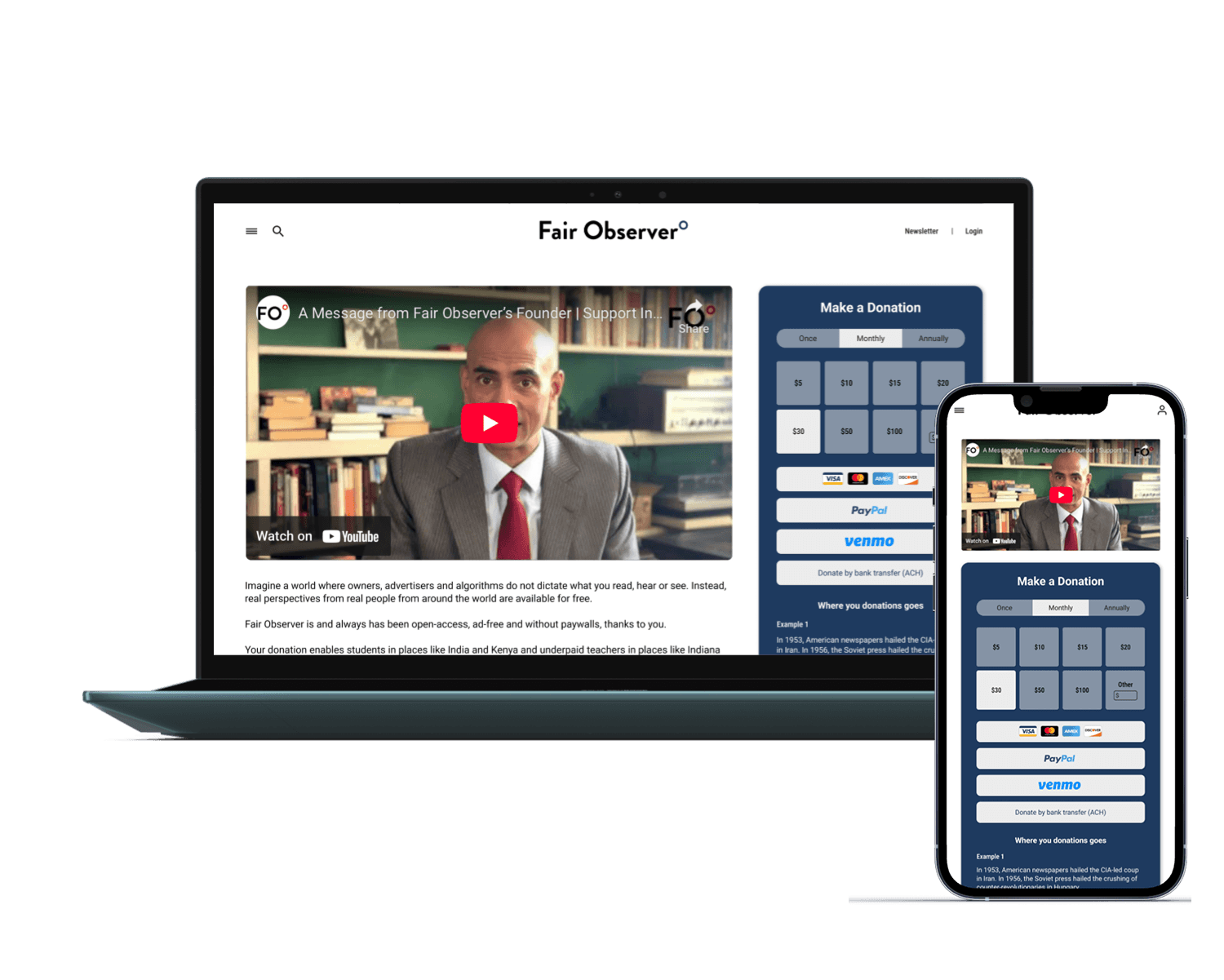
Fair Observer is a nonprofit media organization that relies on reader donations to remain ad-free and unbiased. I'm currently designing donation and subscription flows to increase contribution conversion while maintaining trust and transparency with our mission-driven audience.
My role: End-to-end UX design from research through high-fidelity prototypes, currently in development with engineering team.
User Pain Points:
Existing donation page is wordy and confusing; users struggle to understand the process
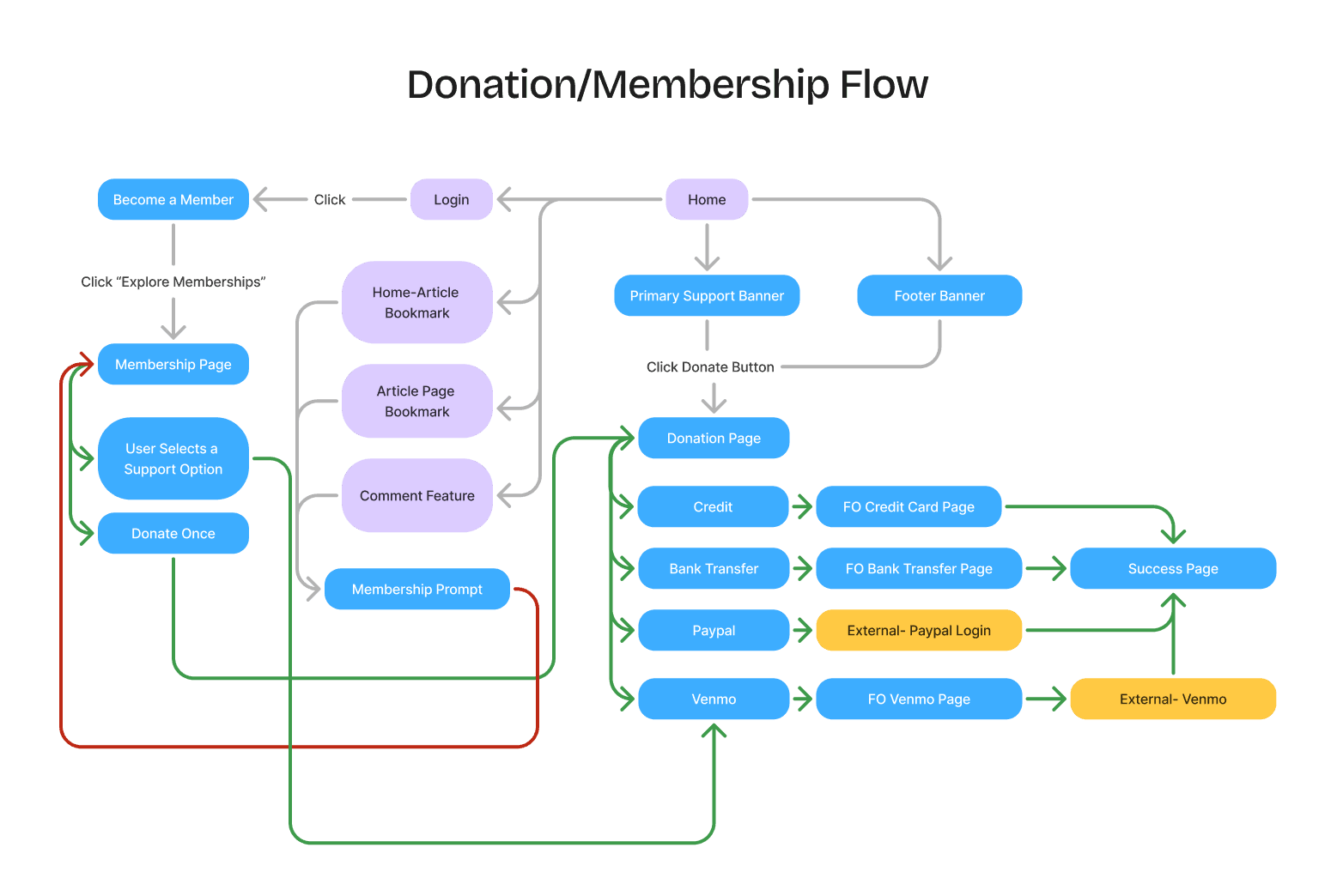
Flow isn't clear with multiple entry points creating inconsistent experiences
No clear hierarchy or visual guidance through the donation journey
Mission-driven audience needs transparency about how donations are used, but messaging is buried in text
Design intuitive donation and membership flows that reduce cognitive load
Create consistent experience across multiple entry points
Establish design patterns for future contribution experiences
Define success metrics for post-launch measurement
Methods
Stakeholder interviews with CEO and CTO to understand business requirements and messaging priorities
Heuristic evaluation of existing donation page to identify usability issues
Competitive analysis of nonprofit donation and membership flows (Wikipedia, NPR, ProPublica, The Guardian)
Content audit to identify essential vs. nice-to-have information
Key Insights
Current page overwhelms users with text; key information gets lost
Multiple entry points created confusion about which donation option to choose
Users need transparency about fund allocation, but don't need essays
Lack of visual hierarchy made it unclear what actions to take
Combining donation and membership options in one flow caused decision paralysis
✨ Approach
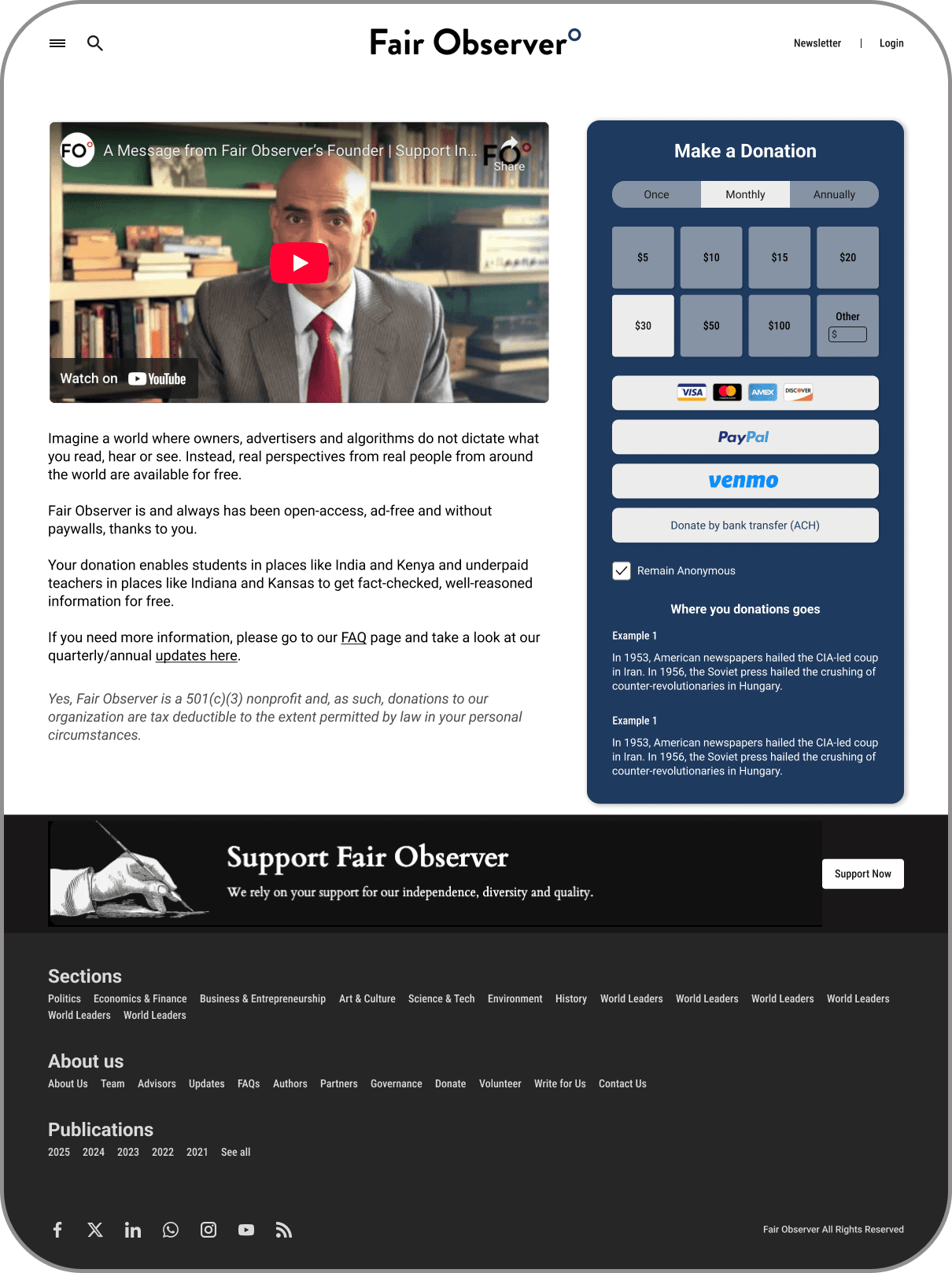
Multi-step flow with clear progress indication to guide users through decision-making
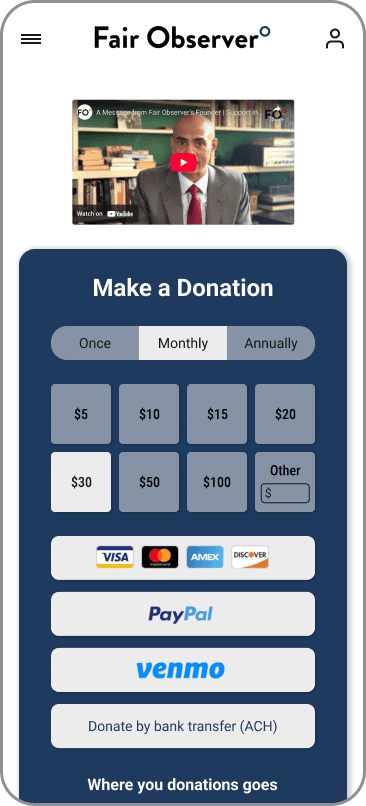
Support all payment methods to reduce barriers (credit/debit, PayPal, bank transfer, etc.)
Anonymous donation option to respect donor privacy preferences
Clear fund allocation messaging: where contributions go and why it matters
CEO message to add personal connection and mission reinforcement
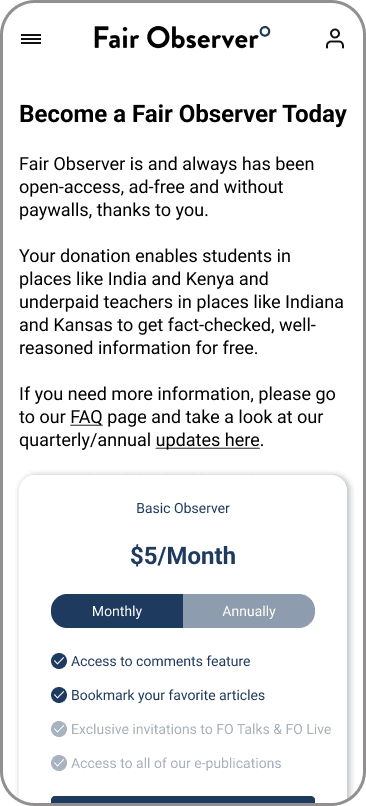
Streamlined copy; essential information only, removing unnecessary text
Visual hierarchy to guide users through choices without overwhelming them
✨ Success metrics defined:
Donation and membership completion rate
Time to complete contribution (goal: reduce from current baseline)
Drop-off points by step (to identify friction)
Anonymous vs. named donor ratio
Payment method distribution
Average contribution amount
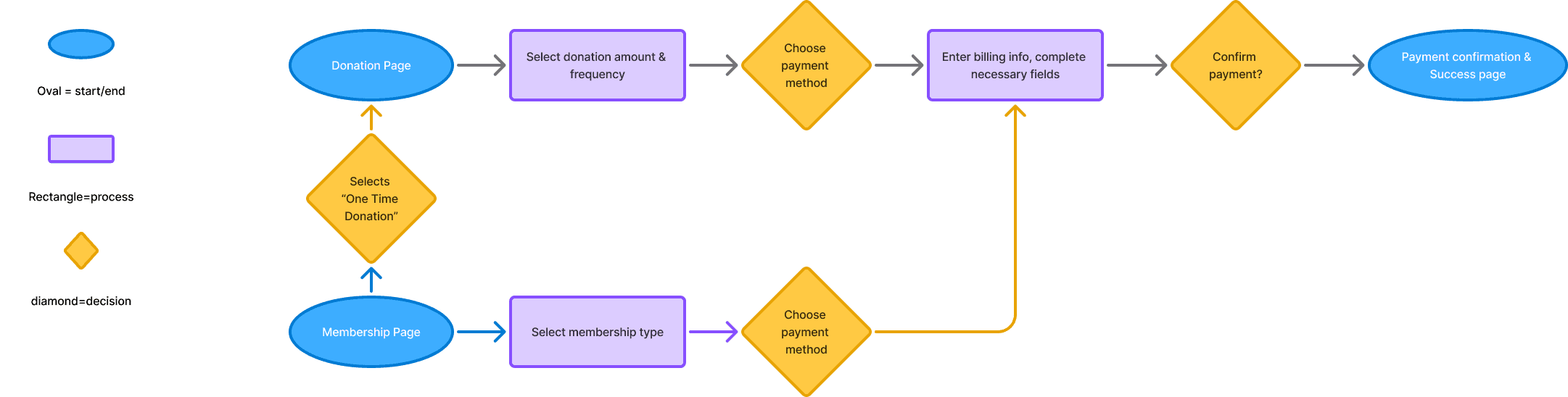
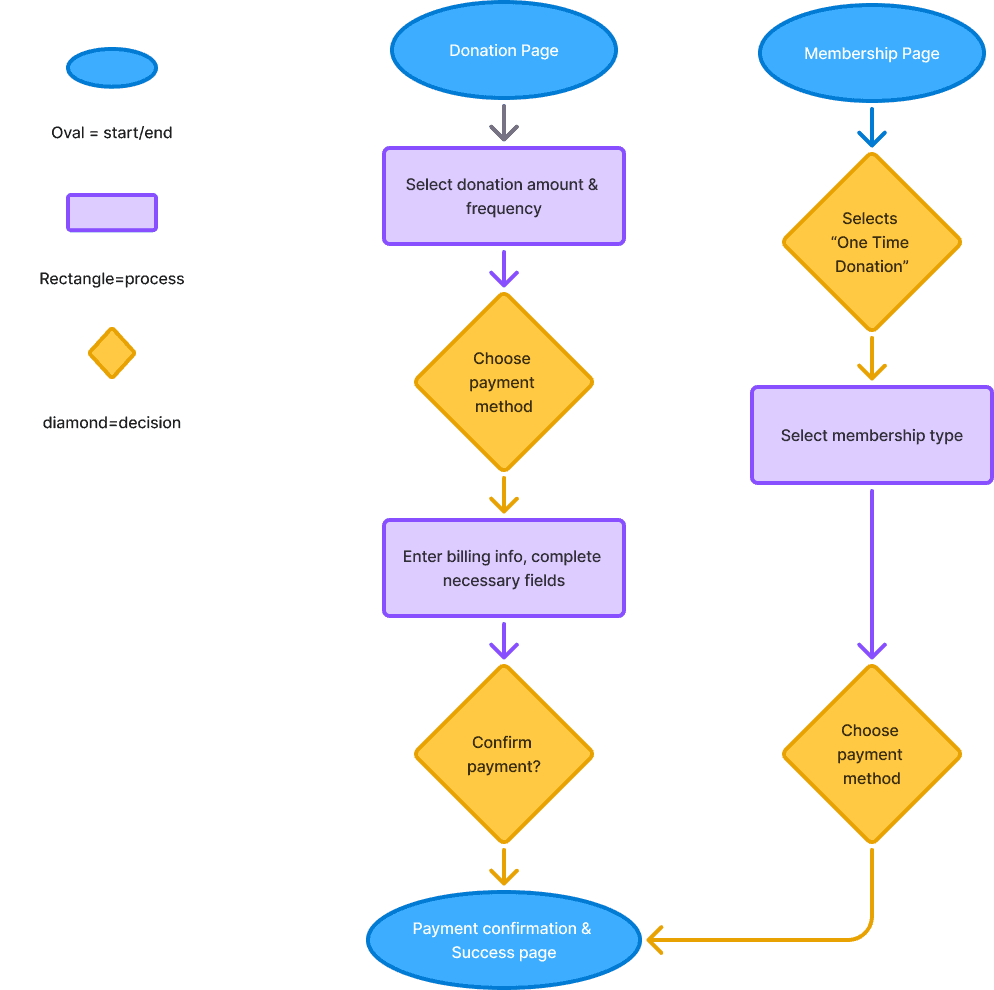
✨ User Flow Mapping
✨ Key Design Decisions
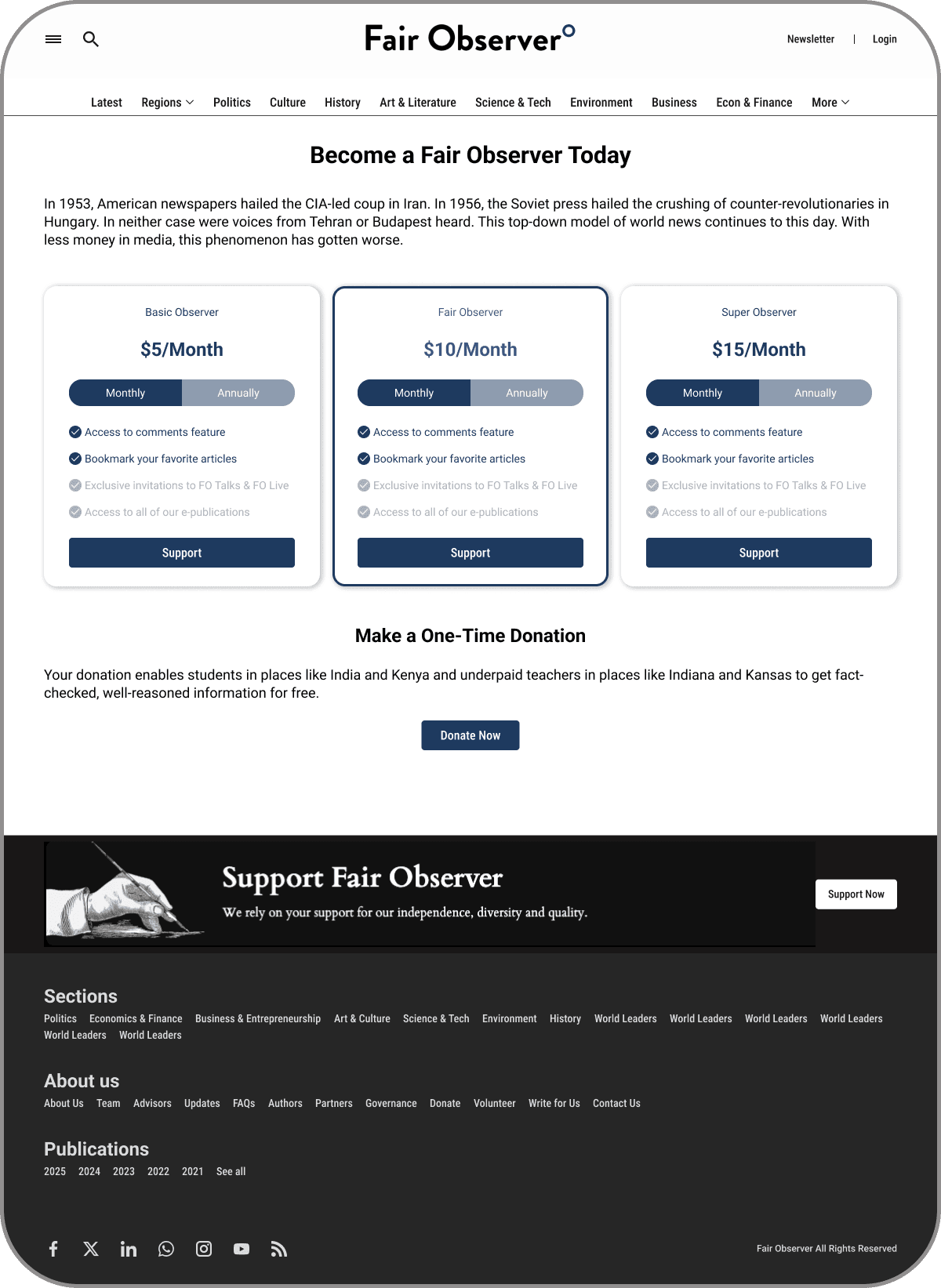
Separated donation and membership flows to reduce decision paralysis
Anonymous donor option positioned clearly without requiring extra steps
CEO message integrated to add personal connection while maintaining flow clarity
Multi-payment method support to accommodate all donor preferences
✨ Contribution Type Selection
Clear distinction between one-time donation vs. membership options
Membership benefits outlined
Visual hierarchy guiding users to appropriate path
✨ Payment Details
All payment methods displayed (credit/debit, PayPal, bank transfer, etc.)
Anonymous donor checkbox with clear explanation
Streamlined form fields with inline validation
CEO message positioned to reinforce mission without interrupting flow
✨ Fund Transparency
Clear breakdown: "Where your contribution goes"
Trust signals (nonprofit status, transparency commitment)
✨ Confirmation
Thank you message
Confirmation of anonymous/named preference
Receipt details
Next steps based on contribution type (member benefits, newsletter, etc.)
Donation & Subscription Figma
New patterns created:
Donation form component library
Payment input standards with validation states
CTA button hierarchy for transactional flows
Error messaging patterns
Success/confirmation page template
Documentation created:
Design specs for engineering handoff
Interaction states and edge cases
Mobile responsive breakpoints
Accessibility requirements (WCAG 2.1)
Metrics we'll track:
Donation conversion rate (target: industry benchmark of 2-5%)
Flow abandonment rate (target: <30%)
Recurring donation adoption (target: 20%+ of total donations)
Mobile conversion rate (target: match or exceed desktop)
Hypotheses to validate:
Multi-step flow with clear progress indication will reduce cognitive load and completion anxiety
Separating donation and membership paths will reduce decision paralysis and increase completion rate
Anonymous donation option will increase participation among privacy-conscious donors
Supporting multiple payment methods will reduce barriers and increase conversion
Streamlined copy will reduce time-to-complete and improve mobile conversion
CEO message will strengthen emotional connection and increase average contribution amount
Current phase: Handoff to engineering (Dec 2025)
Planned:
A/B testing different suggested amounts post-launch
Usability testing with prototype before development
Session recording analysis after launch to identify friction
Iterative improvements based on funnel analysis
What I'm learning:
Designing for mission-driven commerce requires different trust signals than e-commerce
Balancing user needs with business goals in nonprofit context
Importance of designing measurable experiences from the start